

Collagen: what it is, what changes after 50 and what your plate can do
By Marie-José Joly, founder

Collagen is the most abundant protein in the body: in the skin, it forms a network of fibres that gives it its structure. The body makes it itself, from what we eat, and makes less of it over the years. Here is what we know, and what cannot be promised.
What is collagen?
Collagen is a structural protein, the most abundant in the human body. It forms strong fibres found in the skin, bones, tendons, cartilage and blood vessels. In the skin, it makes up most of the dermis, the layer beneath the epidermis.
The word in fact describes a family: a reference review (Ricard-Blum, 2011) lists 28 types, numbered I to XXVIII. In the dermis, types I and III are the main ones. They are made by cells called fibroblasts, which assemble them into a dense network.
An image helps: if the epidermis is the surface we see and touch, the dermis is its framework, and collagen is its main material.
How does the body make its collagen?
The body makes its collagen itself, from the amino acids supplied by the proteins in our food. Several nutrients take part in this process, and one of them is the subject of an official health claim: vitamin C.
In Switzerland, Annex 14 of the FDHA Ordinance on Food Information lists the authorised health claims. For the skin, it reads, word for word: “Vitamin C contributes to normal collagen formation for the normal function of skin.” This sentence may only appear on a food that is at least a source of vitamin C within the meaning of the law.
Conversely, the same text contains no claim for collagen itself, nor for hyaluronic acid. This point is often forgotten when reading the promises on packaging. To understand vitamin C in more detail, read our article on vitamin C and the skin.
What happens to collagen with age?
With age, the skin produces less collagen and the existing network renews itself more slowly. A review published in 2021 in the International Journal of Molecular Sciences (Lee et al.) describes this fall in production in the dermis over the course of chronological ageing.
Two other factors add to the passing of time:
- The sun. According to MeteoSwiss, overly frequent and prolonged exposure to the sun makes the skin age faster. Scientific reviews also describe the effect of UV rays on the dermis.
- The menopause. A review published in 2022 in Clinical and Experimental Dermatology (Kamp et al.) reports that nearly a third of the skin’s collagen is lost in the first five years after the menopause, then around 2% a year over the following fifteen years. The authors stress that this decline is linked to the years since the menopause more than to age itself.
These figures describe averages drawn from studies, not every woman’s destiny. They explain why many women feel their skin changing from 50, and why sun protection remains a gesture for every season. We come back to this in our article on the menopause and the skin.
Can a lack of collagen be measured?
There is no simple test to measure your collagen at home. The lists of “signs of deficiency” found online in fact describe ordinary changes in the skin with age, which have several causes at once.
Genuine disorders of collagen production are medical matters. Scurvy, a severe vitamin C deficiency that has become rare in countries with a varied diet, is the historical example: without vitamin C, the body no longer forms its collagen properly. Some rare genetic diseases of the connective tissue also affect collagen. For any concern, the right person to ask is your doctor.
Where is collagen found in food?
Collagen is found in the connective tissue of animals: the skin of fish and poultry, cuts rich in cartilage, the bones used for a broth, and gelatine. Like any protein, it is digested into amino acids and small fragments before being absorbed.
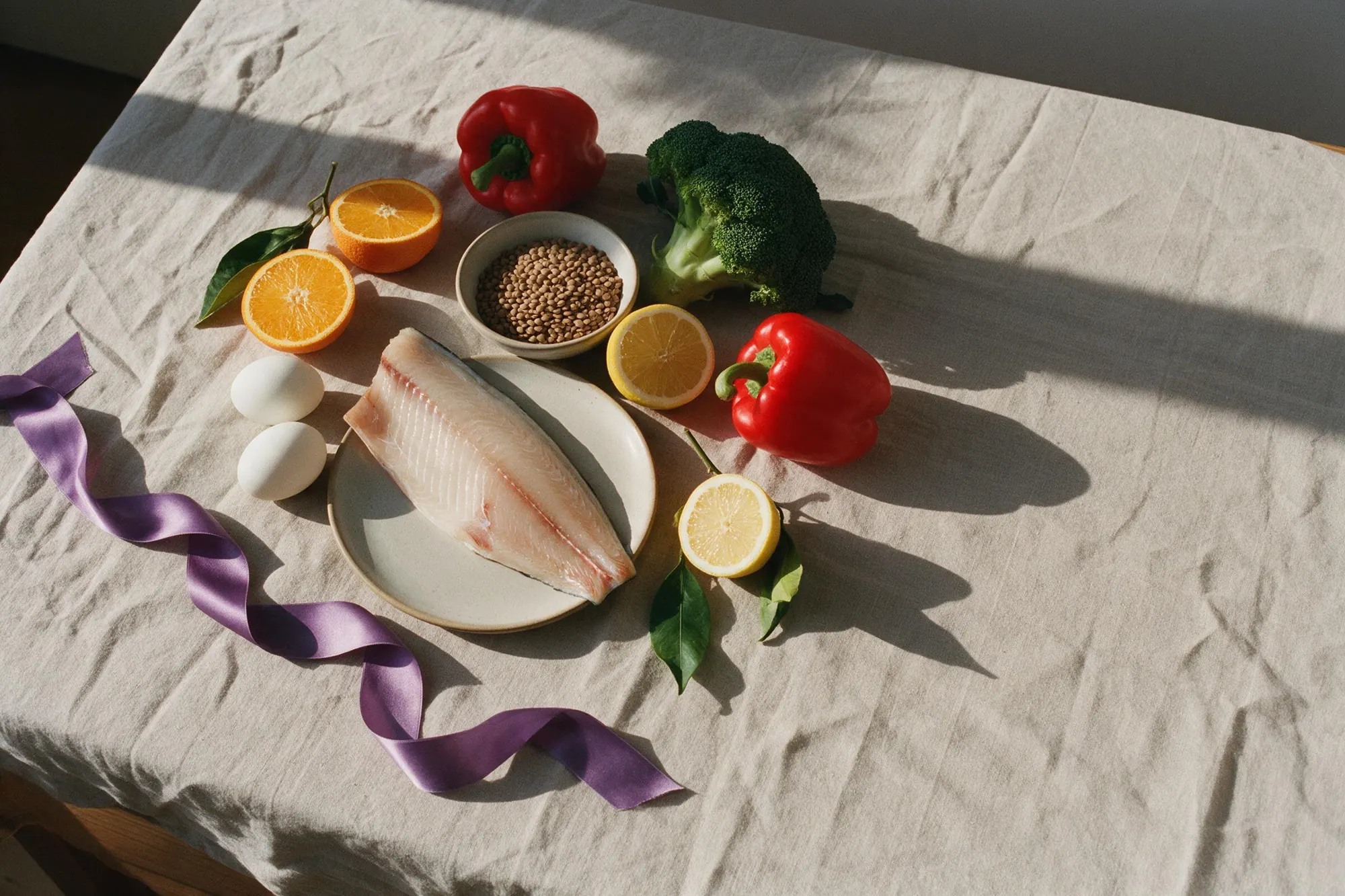
For the body’s own collagen production, what matters most happens on a varied plate: enough protein and enough fruit and vegetables. The Swiss nutrition recommendations give simple pointers: one portion a day of a protein-rich food, varying the sources (pulses, tofu, eggs, meat, fish, seafood), two to three portions of dairy products, and five portions of seasonal fruit and vegetables in a variety of colours.
| Food | What it brings | Swiss guideline |
|---|---|---|
| Lake fish, poultry, eggs | Protein | One protein-rich portion a day, varying the sources |
| Lentils, chickpeas, beans | Plant protein | Pulses at least once a week |
| Cheese, yoghurt, quark | Protein | Two to three portions of dairy products a day |
| Bone broth, gelatine | Dietary collagen, digested like any protein | No specific guideline |
| Pepper, cabbage, broccoli, citrus fruit, kiwi | Vitamin C | Five portions of fruit and vegetables a day |
| Seeds and nuts | A variety of nutrients | A small handful a day |
Drinkable collagen, marine collagen: what can be said?
Drinkable collagen, often called marine collagen when it comes from fish, comes in the form of peptides, that is, small fragments of collagen. In Switzerland, no health claim is authorised for collagen: an honest manufacturer may therefore attribute no effect to it on the label.
We apply the same rule to our own ritual. The You Are Magnifique winter ritual contains marine collagen peptides, in the drinkable bottle as well as in the serum, together with vitamin C, zinc gluconate and hyaluronic acid. Collagen is named in the composition, with no effect attributed to it. The official claims for vitamin C and zinc may only accompany the bottle if the conditions laid down by law are met; the composition and precautions are presented on the key actives page.
One precaution concerns marine collagen: it is of marine origin. If you are allergic to fish or seafood, ask your pharmacist or your doctor for advice before you start. Already taking food supplements? Check your combined intake with your pharmacist or your doctor.
What really matters, at any age
For the skin, the best-established gestures are simple and cost almost nothing. They hold at any age: here are four of them.
- Protect yourself from the sun, according to the day’s UV index, in winter too when you go up into the mountains.
- Eat a varied diet, with enough protein and fruit and vegetables, following the Swiss guidelines.
- Look after your sleep and keep moving: these are not treatments, but pillars of well-being.
- Keep a simple skincare routine, followed regularly. Our article caring for your skin from 50 sets out the basics.
Frequently asked questions
Which foods contain collagen?
The connective tissue of animals: the skin of fish and poultry, cuts rich in cartilage, bone broth and gelatine. The body digests them like any protein. For it to make its own collagen, a varied diet with enough protein and vitamin C remains the foundation.
How can you tell if you lack collagen?
There is no simple test to do at home, and the “signs” listed online mostly describe the ordinary changes in the skin with age. Genuine collagen disorders, such as scurvy or certain rare genetic diseases, are a matter for a doctor.
Is it too late to take collagen at 60?
The question assumes an effect that Swiss law does not allow to be attributed to collagen taken as a drink: no health claim is authorised for it. At 60 as at 40, what counts first is a varied diet, sun protection and regular care. Before any supplement, ask your pharmacist or your doctor for advice.
What is the difference between collagen and hyaluronic acid?
Collagen is a protein that forms fibres; hyaluronic acid is a complex sugar that holds water between those fibres. Both are made by the body and present in the dermis. Our article on hyaluronic acid explains this in detail.
What is marine collagen?
It is collagen extracted from the skin or scales of fish, then broken down into peptides. It is used in food supplements and cosmetics. As for all collagen, no health claim is authorised in Switzerland. People who are allergic to fish should seek advice before consuming it.
Sources
These sources establish general facts. They do not concern You Are Magnifique products. Pages consulted on 23 November 2026.
- Ricard-Blum S., The collagen family, Cold Spring Harbor Perspectives in Biology, 2011 : a family of 28 types of collagen.
- Lee H., Hong Y., Kim M., Structural and Functional Changes and Possible Molecular Mechanisms in Aged Skin, International Journal of Molecular Sciences, 2021 : decline in collagen production in the dermis with age.
- Kamp E. et al., Menopause, skin and common dermatoses. Part 2: skin disorders, Clinical and Experimental Dermatology, 2022 : skin collagen and the years following the menopause.
- FDHA Ordinance on Food Information (SR 817.022.16), Annex 14 : the list of authorised health claims and their conditions (page in French).
- Federal Food Safety and Veterinary Office, Swiss nutrition recommendations for adults : protein, dairy products, fruit and vegetables (page in French).
- National Institutes of Health, Office of Dietary Supplements, Vitamin C : the role of vitamin C in collagen formation, scurvy.
- MeteoSwiss, UV index : the effects on the skin of overly frequent and prolonged sun exposure (page in French).
This article is for information only and does not replace the advice of a doctor, a dermatologist or a pharmacist.
Going further
Collagen rarely comes alone: read also hyaluronic acid explained without promises and vitamin C and the skin. Marie-José Joly, who signs these lines, ran an international school of aesthetics and cosmetics in Switzerland for more than fifteen years; her story is on the About page.
To take stock of your skin and your habits, the Magnifique Longevity Check asks eight questions, with no diagnosis and no medical advice. The In & Out duo page presents the winter ritual and its two gestures. You are magnificent. This ritual is here to remind you.

The author
Marie-José Joly, founder
For more than fifteen years, I ran an international school of aesthetics and cosmetics in Switzerland.
Read her storyKeep reading
How to adapt your beauty routine to the seasons after 50
Yes, it helps to adjust your routine through the year: in Switzerland, cold, heated air and UV intensity change markedly between January...
In & Out beauty: definition and meaning of the approach
In & Out beauty, also called inside-out beauty, links what we apply to the skin (Out) with what we do each day...